Teach Kids to Share Calmly: Timer Turns & Simple Scripts
Sharing Without Showdowns: A Calm, Step-by-Step Plan for Teaching Kids to Share
Sharing problems rarely come from “bad behavior.” Most conflicts happen because kids are still learning impulse control, turn-taking, and how to handle big feelings. A simple, repeatable plan helps parents stay calm, set clear boundaries, and coach children toward cooperative play—without lecturing, bribing, or constant refereeing.
Why sharing turns into fights (and what kids are really practicing)
When two kids want the same thing, they’re not just arguing about a toy—they’re practicing a whole set of skills at once: waiting, negotiating, coping with disappointment, and reading social cues. Those abilities develop gradually, and the gap between “I want it now” and “I can take turns” is where most meltdowns live.
Toddlers often play side-by-side (parallel play) before they can truly share. Expecting instant generosity can backfire and create more grabbing. Add siblings or playdates and suddenly fairness, ownership, and “my turn” become emotional flashpoints—especially around “high-status” toys like trucks, dolls, tablets, or character items.
Sharing gets harder when kids are hungry, tired, overstimulated, or navigating transitions (arriving at daycare, a new house, a new baby, leaving the park). A calm adult response helps kids build the brain skills that support self-control and empathy over time. For milestones and social-emotional development context, see the CDC developmental milestones and guidance from HealthyChildren.org (American Academy of Pediatrics).
Set the stage: simple rules that prevent power struggles
Most sharing battles are easier to prevent than to “solve” mid-scream. A few house rules and predictable routines reduce the number of hot moments and make your response feel fair to everyone.
1) Create “always share” and “special” toy categories
Designate a bin or shelf of “always share” toys for playdates and common areas. Let kids choose a few “special” toys that can be put away or shared only by choice. This protects attachment items and reduces fear-based hoarding.
2) Use turn-taking language that never changes
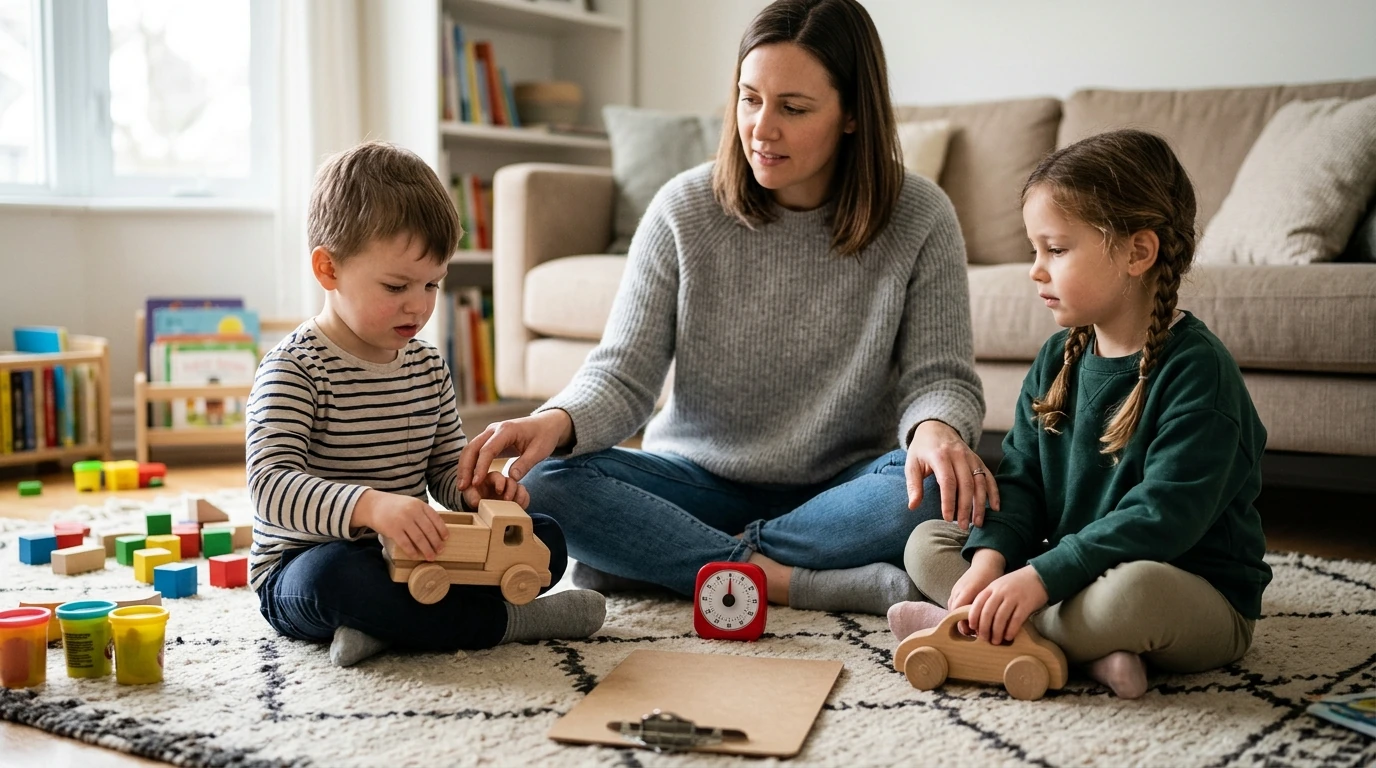
Keep it simple and consistent: “You can have a turn when the timer beeps.” Predictability lowers the need to argue and gives kids a clear finish line.
3) Add duplicates for high-conflict items when possible
Two trucks, two dolls, or extra scoops can be a surprisingly effective peace strategy. When duplicates aren’t possible, offer “near matches” (same type, different color) to reduce rivalry.
4) Plan the first 10 minutes of a playdate
Start with a structured activity (play-dough, a simple craft, snack, or bubbles). Early structure reduces the initial toy-rush that often triggers grabbing.
5) Teach one short asking script
Pick a single sentence kids can copy: “Can I have a turn when you’re done?” Practice it during calm moments so it’s available under stress.
The calm conflict script: what to say when grabbing starts
Step 1 — Pause and name the moment
Step 2 — Hold the boundary
Step 3 — Validate both sides (no villains)
Step 4 — Give two clear options
Step 5 — Follow through gently
| Situation | What to say | What to do next |
|---|---|---|
| Child grabs a toy | “I won’t let you grab. Ask for a turn.” | Return toy to the current player; prompt the asking script |
| Both kids yelling “Mine!” | “You both want it. Let’s make a turn plan.” | Set a 2–5 minute timer; confirm who goes first |
| One child won’t give it up after a turn | “Timer says it’s time to switch. I’ll help.” | Physically assist the handoff; offer a transitional choice |
| Child refuses any plan | “It’s hard to wait. I’m here. The rule is safe hands.” | Move the child to a calm spot; try again when regulated |
| Playdate guest wants a ‘special’ toy | “That one is put away today. You can choose from these.” | Offer a curated set of shareable toys; redirect to joint play |
After the storm: repair, practice, and build long-term skills
Emotional literacy helps kids catch themselves earlier. Teach simple body cues—tight fists, loud voice, fast hands—as signals to pause and ask for help. For more toddler-specific developmental guidance, Zero to Three offers practical, age-appropriate explanations.
Using a printable checklist to stay consistent when emotions run high
Posting a quick-reference plan in a visible spot (playroom or fridge) also lets kids “borrow” the language. For a ready-to-print version, see the Sharing Without Showdowns printable checklist.
To make the system even easier, pair your checklist with a small “peace kit”: a simple timer, a couple of high-interest duplicates, a snack/water option, and a calm-down corner item. For more ideas that strengthen cooperation outside of conflict, the Connected at Home family bonding guide can add structured connection that often reduces rivalry.
If sharing battles spike around separations (drop-offs, travel, one parent away), extra comfort and predictability can prevent “toy guarding” behaviors. The 10 loving ways to comfort a child who misses a parent checklist can help you build a steadier emotional baseline before play begins.
When sharing struggles signal something else
FAQ
At what age should kids be expected to share?
Many toddlers aren’t developmentally ready for true sharing because impulse control and turn-taking are still emerging. Skills typically improve through the preschool years with adult coaching, short turns, and realistic expectations.
Should parents force a child to share their favorite toy?
Forced sharing often backfires and can create more guarding and resentment. It’s usually better to put “special toys” away during playdates while coaching safe behavior and turn-taking with the “always share” toys.
What can be done when siblings fight over the same toy every day?
Use a repeatable plan: timer turns, duplicates when possible, rotating toys, and setting up cooperative activities that require teamwork. Consistency (same script, same follow-through) is what turns daily fights into teachable routines.








Leave a comment